
Policy Brief
Thematic Area: Trade, Investment, and Resilient Supply Chains

Digital Trade: Trends, Policy Insights, and Pathways for Growth
Introduction
The use of digital technologies has eased business transactions, facilitating smooth operations across sectors. According to the International Telecommunication Union (ITU), the number of global internet users increased from 1 billion in 2005 to 6 billion in 2025, while the percentage of the population using the internet rose from 16% to 74%1. Internet connectivity serves as a strong indicator of integration of advanced technologies at both household and industrial levels. The percentage of the population covered by a mobile-cellular network has increased by at least 94% in all regions (table 1).
Table 1: Population Covered by a Mobile-Cellular Network
| Parameters | 2007 | 2025 |
|---|---|---|
| Africa | 57.7 | 94.1 |
| Americas | 93.9 | 97.0 |
| Arab States | 87.7 | 98.1 |
| Asia-Pacific | 80.7 | 99.1 |
| CIS | 76.1 | 99.3 |
| Europe | 98.8 | 99.8 |
Source: International Telecommunication Unit2
This internet revolution led to the rise of digital services, which are delivered across nations through computer networks, transforming the way businesses and individuals interact globally. This was followed by a deeper integration of advanced technologies, including artificial intelligence, which processes large amounts of data to enable smarter decision-making, automation, and personalized services. The transfer of large volumes of data over the internet has created a growing need for digital trade across countries, facilitating cross-border transactions and global e-commerce.
Digital Trade
According to the OECD, WTO, and IMF (2019), "digital trade is all international trade that is digitally ordered and/or digitally delivered." Digital trade is a subset of a broader concept of international trade, which combines the concepts of digital ordering and digital delivery. Digitally delivered trade is defined as "all international trade transactions that are delivered remotely over computer networks." Digital delivery comprises of services, as only services can be delivered digitally. Digital ordering (OECD, 2011), on the other hand, can be defined as "the international sale or purchase of a good or service, conducted over computer networks by methods specifically designed for the purpose of receiving or placing orders." Therefore, digitally ordered trade essentially corresponds to international e-commerce and includes transactions involving both goods and services3.
A digitally delivered service is one in which both the ordering and the delivery occur online. For example, streaming a video is digitally delivered because the entire service is transmitted over the internet. In contrast, a digitally ordered service is one where the order is placed online, but the service itself is delivered physically. A common example is booking a taxi through mobile platforms, where the request is made digitally, but the actual service is provided offline. This distinction highlights that not all digitally ordered services are digitally delivered. Furthermore, digital ordering happens instantly, while digital delivery may take more time and can involve interpersonal interaction. However, any human interaction involved in digitally delivered services occurs remotely through computer networks4.
Exports of digitally delivered services can be used as an indicator of digital trade as they capture actual cross-border digital value flows, where the service itself is produced in one country and delivered to another entirely through digital networks. Unlike digitally ordered services, which only reflect how a transaction is initiated and may still be delivered physically or locally, digitally delivered services depend fundamentally on digital infrastructure, data flows, and ICT systems.
A study by Yuna et al., (2022) discussed that digital infrastructure; human capital; and science, technology, and innovation capacity have a substantial impact on digitally deliverable trade. The research concluded that, as digital trade continues to account for a growing share of global commerce, developing countries need to prioritize expanding digital infrastructure, strengthening workforce skills, actively advancing digital technologies, and boosting their overall capacity for innovation5. Another study by Suh et al., (2023) postulated that impact of unilateral domestic regulations and bilateral trade agreements on the flow digital trade. The analysis showed that digital trade volumes rise when countries are linked by trade agreements that include provisions specific to digital trade. In contrast, domestic regulatory measures identified as obstacles to digital trade tend to restrict such flows, with regulations imposed by importing countries having a more pronounced adverse impact than those introduced by exporters6.
Wu et al. (2023) found that digital trade rules play a strong role in boosting service exports within global value chains (GVC), with a larger effect on forward GVC service exports than on backward ones. They also showed that the extent of this trade-enhancing effect varies depending on countries' income levels, the nature of the preferential trade agreements involved, and cross-country differences in regulatory quality7. Therefore, it is in this context that measuring digital trade will reflect the need for greater investments in domestic digital infrastructure, greater provisions of digital trade in bilateral trade agreements, and clearer and supportive rules for digital trade that are part of global production networks.
Digitally Delivered Services Exports
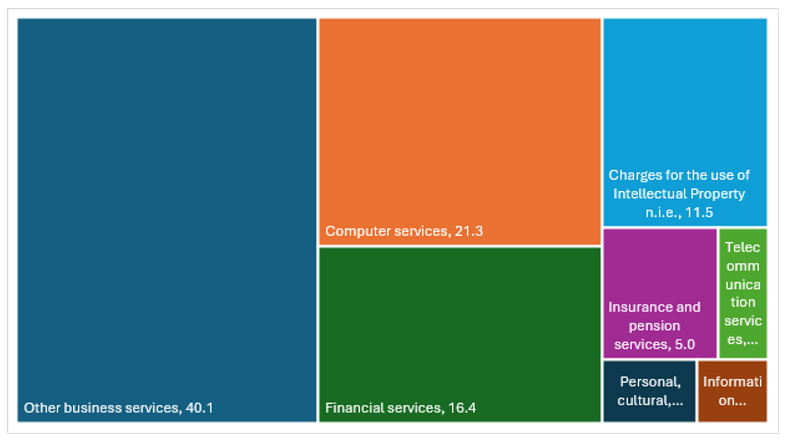
Global exports of digitally delivered services increased from USD 2.23 trillion in 2014 to USD 4.77 trillion in 2024 at compound annual growth rate (CAGR) of 7.90%8. The structure of digitally delivered services exports in 2024 is dominated by other business services, followed by computer and financial services. Collectively, these categories account for the bulk of exports, highlighting the growing importance of professional, IT-enabled, and financial services, while telecommunications and information services contribute relatively smaller shares.
Figure 1: Composition of Digitally Delivered Services Exports, 2024 (%)
Source: World Trade Organization (WTO) estimates
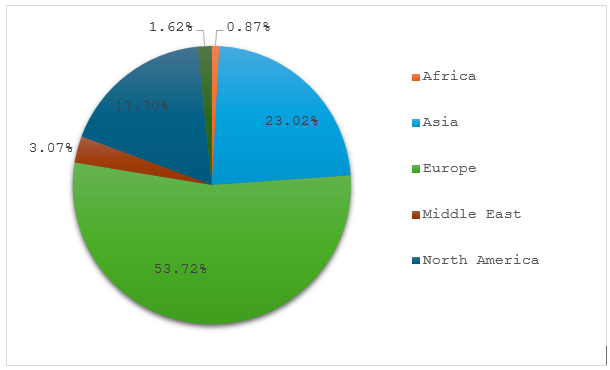
From a regional perspective, Europe accounts for almost 54% of the world's exports of digitally delivered services, followed by Asia (23.0%), North America (17.7%), the Middle East (3.0%), South and Central America and the Caribbean (1.62%), and Africa (0.87%).
Figure 2: Region-wise Breakup of Digitally Delivered Services, 2024 (%)
Source: WTO Estimates
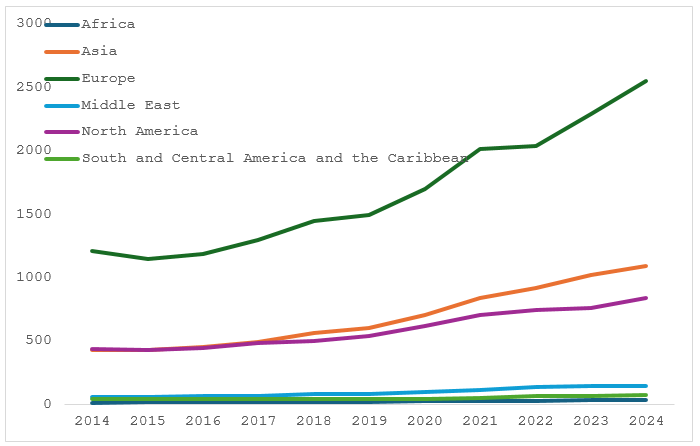
Figure 2 suggests that while Europe accounts for large proportion of digitally delivered services such as the Internet, apps, emails, voice and video calls, and digital intermediation platforms9, developing economies of Asia and Africa are expanding faster at a CAGR of 8.42% and 9.71%, which in turn reflects the gradual investments by developing economies in stepping up their digital public infrastructure.
Figure 3: Region-wise Export of Digitally Delivered Services (USD billion)
Source: WTO Estimates
India's "India Stack" initiative provides a model for developing countries to adopt three layers of digital inclusion: identity (Aadhar), finance (UPI), and market (Open Network for Digital Commerce). Such initiatives boost digital trade by creating interoperable digital public infrastructure. Digital identity enables secure online identification, financial infrastructure facilitates instant digital payments, and digital marketplaces reduces entry barriers, lowering transaction costs, and enabling businesses and consumers to participate seamlessly in cross-border and domestic digital services.
Recommendations
Greater Provisions of Digital Trade in FTAs: The top five countries with the highest number of digital trade chapters are Singapore, Australia, the Republic of Korea, Chile, and the United Kingdom10. From 2014 to 2024, digitally delivered services exports of these countries have expanded at robust compound annual growth rates (CAGRs) of 13.59%, 5.95%, 9.78%, 7.97%, and 6.85%, respectively. This suggests that deeper commitments to digital trade rules are interrelated with stronger growth in digitally delivered services, reflecting improved regulatory certainty, market access, and digital interoperability. According to the OECD, nearly half of all trade agreements now contain digital trade provisions, reflecting their growing importance in regional trade frameworks, incorporating the WTO Agreement on E-commerce into the WTO system could raise digital trade integration by 21% if adopted by the 71 supporting economies, and by up to 244% if implemented by the full WTO membership11.
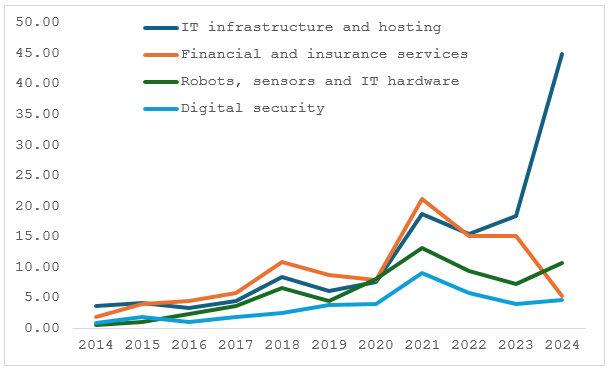
Enhanced Investments in Artificial Intelligence: IT infrastructure and hosting (cloud services, data centers, platforms) can be considered as essential enablers of digitally delivered services and cross-border e-commerce. Higher venture capital (VC) funding usually corresponds to higher growth in digital markets and trade-related services. Further, sectors such as financial and insurance services; robotics, sensors, IT hardware; and digital security also play a critical role in supporting the growth and efficiency of digitally delivered services and cross-border e-commerce.
Figure 4: VC investments in AI by industry (USD billion)
Source: OECD.AI (2025), data from Preqin, last updated 2025-10-01, accessed on 2025-12-16, https://oecd.ai/
In this context, industries such as financial and insurance services; robots, sensors and IT hardware; and digital security have experienced fluctuations or declines in venture capital investment in recent years. Increasing investment in these sectors would strengthen the underlying infrastructure and services that support digitally delivered services, from secure financial transactions to advanced hardware and cybersecurity. Enhanced funding would drive innovation, efficiency, and reliability, enabling more robust cross-border digital trade.
Clear and well-established trade policies: To promote digital trade, governments can promote transparent and consistent investment and trade policies that encourage both domestic and foreign funding in essential digital infrastructure, including data centers and broadband networks. Coordinated regulations, stakeholder engagement, and public-private collaboration can enhance connectivity, attract investment, and strengthen global digital trade12. Furthermore, Meltzer (2019) suggests that international regulatory cooperation, including the development of common standards and mutual recognition agreements in areas like privacy and consumer protection, can reassure domestic regulators that permitting cross-border data flows will not compromise national regulatory objectives. Therefore, structured domestic trade policies and international regulatory cooperation will facilitate greater digital trade flows among countries.
In conclusion, stronger digital trade provisions, increased investment in digital infrastructure, and clear, coordinated trade policies are essential for expanding digitally delivered services and cross-border e-commerce. Such policies can enhance market access, bridge digital divides, and promote sustainable growth in the global digital economy.
Note:
1.https://www.itu.int/en/ITU-D/Statistics/Pages/stat/default.aspx
2.https://www.itu.int/en/ITU-D/Statistics/Pages/stat/default.aspx
3.https://www.wto.org/english/res_e/booksp_e/digital_trade_2023_e.pdf
4.https://www.wto.org/english/res_e/booksp_e/digital_trade_23_ch4_e.pdf
5. AUTHOR=Di Yuna, Zhi Ruixin, Song Huaixi, Zhang Lu; TITLE=Development and Influencing Factors of International Trade in Digitally Deliverable Services; JOURNAL=Frontiers in Psychology; VOLUME=Volume 13 – 2022; YEAR=2022; URL = https://www.frontiersin.org/journals/psychology/articles/10.3389/fpsyg.2022.908420; DOI=10.3389/fpsyg.2022.908420; ISSN=1664-1078
6. Suh, J., & Roh, J. (2023). The effects of digital trade policies on digital trade. The World Economy, 00, 1–21. https://doi.org/10.1111/twec.13407
7. Wu, J., Luo, Z., & Wood, J. (2023). How do digital trade rules affect global value chain trade in services?—Analysis of preferential trade agreements. The World Economy, 46, 3026–3047. https://doi.org/10.1111/twec.13412
8.https://www.wto.org/english/res_e/statis_e/gstdh_digital_services_e.htm
9.https://www.wto.org/english/res_e/statis_e/gstdh_digital_services_e.htm
10.https://www.wto.org/library/events/event_resources/ecom_1310202514/954_2959.pdf
11.https://www.oecd.org/en/topics/policy-issues/digital-trade.html