
Policy Brief
Thematic Area: Trade, Investment, and Resilient Supply Chains
Unlocking Africa's Value Chain Potential: Strategic Pathways Forward
Introduction
Africa, the world's second-largest continent, is home to nearly 1.5 billion people, representing about 18% of the global population. The continent's economy is projected to grow steadily, with growth rates expected to rise from 4.2% in 2025 to 4.3% in 2026 and 4.4% in 20271. Africa's economic landscape is characterized by abundant natural resources, a rapidly expanding base of dynamic enterprises, a deepening pool of entrepreneurial talent, and a young, fast-growing population that offers significant long-term growth potential2.
World bank data indicate a modest structural shift in Africa's economy between 2014 and 2024. The share of agriculture, forestry, and fishing in GDP increased from 15.6% to 18.0%, highlighting a growing reliance on primary activities. Manufacturing value added also declined slightly, while services experienced a marginal contraction. Gross capital formation remained relatively stable, suggesting steady investment levels despite limited progress in industrial and services-led expansion.
Table: Indicators of Africa's Economy
| Indicators (% of GDP) | 2014 | 2024 |
|---|---|---|
| Agriculture, forestry, and fishing, value added | 15.6 | 18.0 |
| Manufacturing Value Added | 10.2 | 9.9 |
| Services Value Added | 51.3 | 49.6 |
| Gross Capital Formation | 24.8 | 24.1 |
Source: World Bank Data
Global Value Chains (GVCs)
GVCs can be referred to as international framework of production, where the production process, which was earlier located in one single country, is now placed in multiple countries. A product may be manufactured in Country A, assembled in Country B, and completed as a final good in Country C. GVCs are an important driver of growth, as it enables transfer of technical knowledge among countries. It places importance on both aspects of trade, as it is only through the importation of intermediate inputs that firms in the next stage of production can add value and move the production process forward3.
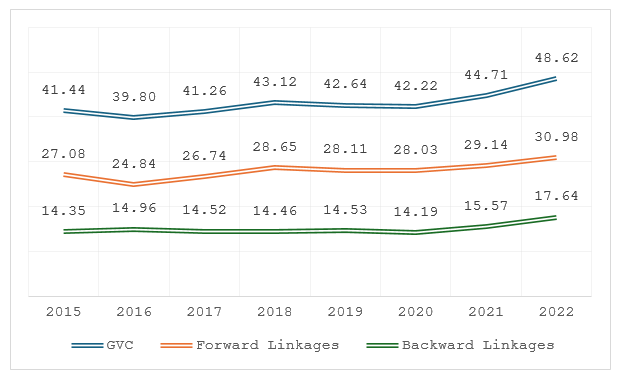
Statistically, GVCs can be calculated as the sum of backward linkages and forward linkages. Backward linkage shows how much a country depends on foreign inputs to produce its exports, while forward linkage shows how much a country's exports are used by other countries to produce their exports. The former can be measured by foreign value added in gross exports as percentage of gross exports, while the latter can be measured by domestic value added in foreign gross exports as percentage of total economy gross exports4.
Data suggests that Africa exhibits higher forward linkages, potentially reflecting a pattern in which the region exports raw materials and primary goods that are subsequently used by other countries to produce and export finished products. Such primary products including minerals, oil, and agricultural commodities tend to contribute value at the early stages of global production before being further processed abroad. In contrast, relatively lower backward linkage may indicate that the region imports fewer intermediate inputs for export production, which could point to limited integration into manufacturing intensive segments of global value chains.
Figure 1: Backward Linkage, Forward Linkage, and GVC Participation for the African region (% of Gross Exports)
Source: Trade in Value Added Database (TIVA), 20255; Accessed on 27 April 2026
Further, Africa's total exports to the world in 2024 amounted to USD 646.67 billion, of which agriculture and natural resource exports together accounted for USD 352.28 billion, exceeding the value of manufacturing exports (USD 293.71 billion)6. This further strengthens the argument that Africa's higher exports of primary commodities are used for further production by other economies, thereby enabling higher forward linkages. Another important factor is the lower level of industrial diversification across many African economies, which constrains their ability to move up the value chain and limits the development of strong backward linkages.
Strengthening Africa's GVC Participation Through Industrial Capacity and Enhanced Connectivity
A major constraint on Africa's GVC participation is the continued export of natural resources, which has increased from USD 219.63 billion in 2019 to USD 265.52 billion in 20247. While a resource rich Africa provides an avenue for the World economy to leverage the continent's abundant natural resources, there is a need to strengthen the industrial capacity of the region in manufacturing, agro-processing, automotive components, and textiles. That is, there is a need to transition from raw material exports to higher-value segments of value chains, thereby strengthening the region's backward linkages and enhancing its overall participation in global value chains (GVCs).
UNCTAD (2023) highlights that Africa's subdued competitiveness stems from limited technological upgrading and insufficient value addition, noting that manufactured exports remain disproportionately low across most economies8. Similarly, the African Journal of Science, Technology, Innovation and Development in a paper titled "Introduction to the Special Issue: Leveraging Global Value Chains for innovation and industrialization in Africa" emphasizing the need for robust industrial and innovation policies, human-capital development, and SME upgrading to enable firms to meet international standards and integrate into global production networks9.
UNCTAD's Economic Development in Africa Report 2024 emphasizes that inadequate infrastructure, especially cross-border transport and digital connectivity is one of the biggest barriers to building resilient regional and global linkages10. Enhancing these systems is vital for supporting higher-value production, as improved connectivity reduces delays, strengthens supply reliability, and attracts investment from global lead firms.
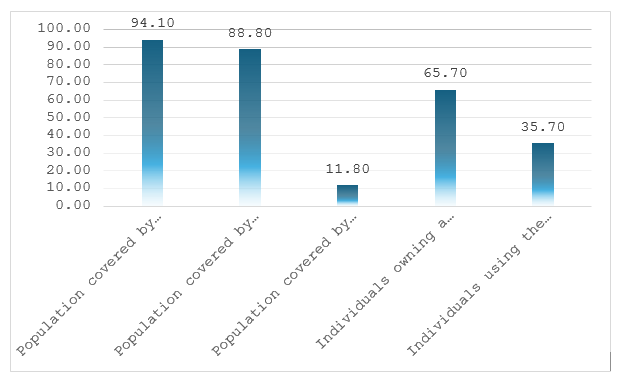
Research from the Programme for Infrastructure Development in Africa (PIDA) shows that inadequate infrastructure across the continent slows economic growth by about 2% each year and reduces productivity levels by as much as 40%11. For instance, mobile connectivity in Africa shows significant variation in access and usage. With 94.10% of the population covered by mobile cellular networks and 88.80% having access to at least 3G services, only 11.80% is covered by 5G, reflecting limited advancement in high-speed infrastructure. With mobile ownership at 65.70% but internet usage at just 35.70%, Africa's digital divide restricts the adoption of advanced technologies required for modern manufacturing and service-led value chains.
Figure 2: Status of Internet Infrastructure in Africa (% of Population), 2025
Source: International Telecommunication Union
Strengthening both digital and physical infrastructure is therefore pivotal to unlock value-added growth. Better connectivity and efficient transport systems will facilitate smoother movement of intermediate goods, reduce transaction costs, and enable firms to upgrade within value chains rather than remaining stuck in primary commodity export roles.
In this context, the African Continental Free Trade Area (AfCFTA), launched in 2021 under the AU's Agenda 2063, provides a critical platform for driving industrialization12. By lowering intra-continental trade barriers and easing access to regional markets, AfCFTA can enhance backward linkages by encouraging firms to source intermediate goods from within Africa. Evidence suggests that African exports have historically contained low levels of African-made intermediate inputs, but reduced tariffs and rising FDI under AfCFTA are positively supporting the development of regional supply chains13, promoting value addition rather than raw material extraction.
In conclusion, Africa's limited industrial capacity and infrastructural challenges limit its movement into higher-value segments of global value chains. Strengthening digital and physical connectivity, alongside AfCFTA-driven market integration, will lower trade costs and support regional sourcing of intermediate goods. With improved infrastructure and investment, Africa can gradually shift from raw material dependence toward more competitive, value-added production across the continent.
Note:
1. IMF Datamapper
2.https://www.brookings.edu/wp-content/uploads/2025/01/Foresight-Africa-2025-2030-Chapter-1.pdf
3.https://www.worldbank.org/en/topic/global-value-chains
4.https://share.google/sdZPHihV1tLk81fIz
5.Trade in Value Added Database (TIVA), OECD Data Explorer
6. Based on data from ITC Trademap
7. Oluseye Jegede & Mammo Muchie (2024) Introduction to the Special Issue: Leveraging Global Value Chains for innovation and industrialization in Africa, African Journal of Science, Technology, Innovation and Development, 16:4, 451-458, DOI: 10.1080/20421338.2024.2361952. https://doi.org/10.1080/20421338.2024.2361952
8.https://unctad.org/publication/economic-development-africa-report-2023
9. Jegede, Oluseye & Muchie, Mammo. (2024). Introduction to the Special Issue: Leveraging Global Value Chains for innovation and industrialization in Africa. African Journal of Science, Technology, Innovation and Development. 16. 451-458. 10.1080/20421338.2024.2361952.
10.https://unctad.org/publication/economic-development-africa-report-2024
12.https://au.int/en/african-continental-free-trade-area
13. de Melo, J., Solleder, JM. How can the African Continental Free Trade Area (AfcFTA) help develop regional value chains across Africa? An exploration. Rev World Econ 161, 121–149 (2025). https://doi.org/10.1007/s10290-024-00574-0